Catch what reviewers will catch, before you submit.
scime draft · a LaTeX workspace for ML papers · by Latentic Labs
Write with your co-authors, then let scime check what reviewers will — every reference, the venue rules, the claims you make — and help you answer the reviews when they come back.
Read along in your languageA translation under each paragraph in Korean, Japanese, Chinese and 5 more; the paper stays in English.
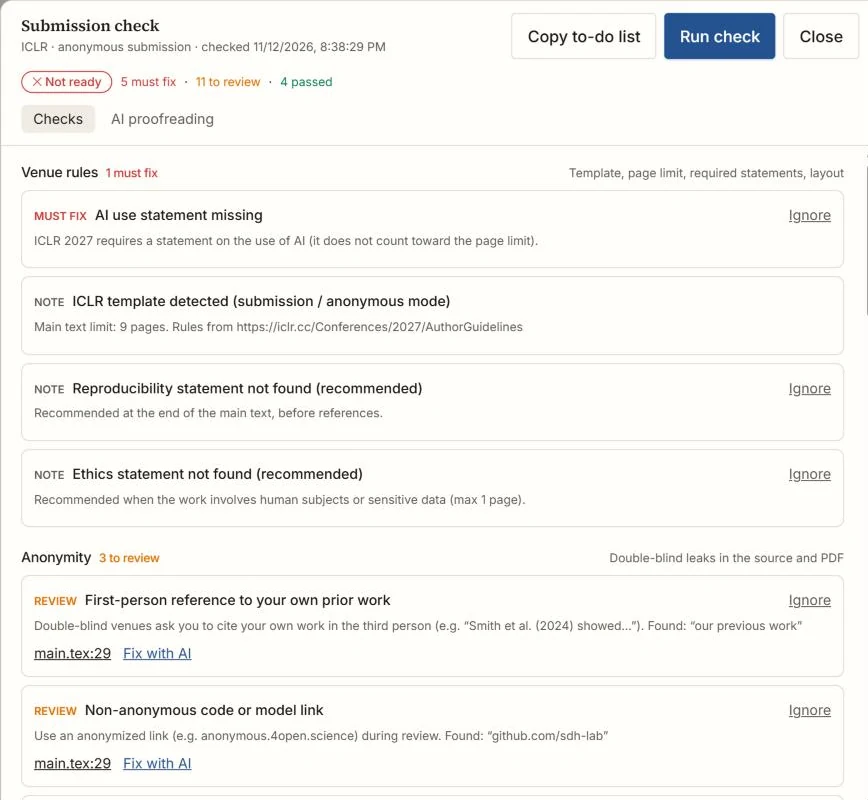
The same report as text
Check
Finding
Status
References
38 of 40 found on arXiv, DBLP or Crossref
2 need a look
Page limit
Main text 8.6 of 9 pages (ICLR)
passed
Anonymity
github.com/jdoe link in Section 4
review
Typos & grammar
“trasnformer” (line 212), “a LSTM” (line 88)
2 to fix
Figures & tables
Figure 4 is never referenced in the text
review
AI-use statement
Required by ICLR 2027
present
Figure 1. What a submission check report looks like, for an example paper. The full report is free for every paper.
Check your paper now, no sign-up
Free, no account needed.
Drop the ZIP of your LaTeX project (in Overleaf: Menu → Download → Source). The quick check reads the source for venue rules, anonymity leaks, missing figures and labels, cite keys missing from your .bib, and typos.
· Up to 100 MB; venue rules for ICLR, NeurIPS, ICML, ACL and CVPR
· Checked in memory and not stored
· Rules only, no AI: your source is not sent to any AI model
· The page limit and reference lookups need the full check after sign-up
Journal articles in Word, theses, technical reports and talks: the checks that matter everywhere, and the formats people outside machine learning write in.
Set a journal, conference, thesis or grant deadline; get reminders 14, 7 and 1 days before, with what is left to fix.
1What the submission check catches
The small things that get papers desk-rejected or marked down, each with a link to the exact line.
Venue rules
Page limit from the compiled PDF, required statements and checklists, old templates, changed margins or fonts.
References
Every \cite looked up on arXiv, DBLP, Crossref and OpenAlex; wrong IDs, mismatched titles, missing keys.
Missing items
Figures and tables never referenced, missing captions and image files, empty sections, broken \ref.
Typos & grammar
Misspellings, one-off variants of your own terms, repeated words, a/an errors, mixed US/UK spelling.
Anonymity
Self-citations in the first person, GitHub links, acknowledgments, emails and PDF metadata.
Experiments
A results section with tables and figures, and the datasets and baselines close papers report.
AI-style phrasing
Words reviewers often read as AI filler — flagged as advice, never as a verdict.
AI proofreading
Grammar fixes, experiment gaps, inconsistent numbers and plain rewrites, on the free scime model or your own key.
2Before you run the experiment
Planning a change — a bigger LoRA rank, a larger batch, a higher sampling temperature? Write the idea in idea.md and the project shows, by itself, what accepted papers reported when they made a similar change: helped, no clear effect, hurt or mixed, each with that paper's own numbers and a link to it.
Change in the paper
Reported
Result
LoRA rank 8 → 16 ScamNet, AAAI 2025
F1 0.47 → 0.65
Helped
LoRA rank 32 → 64 LaDeCo, CVPR 2025
Layout score 8.08 → 8.10
No clear effect
Decoder LoRA rank 32 → 64 ExPLoRA, ICML 2025
Top-1 60.15 → 59.21
Hurt
Figure 2. Three of the papers Already tried? lists for the idea “raise the LoRA rank”. Findings are read from the full text of 126,758 papers from ICML, NeurIPS, ICLR, CVPR, AAAI, ICCV, ECCV, TPAMI, IJCV and JMLR. Papers report gains more often than failures, so the shares describe what gets published, not the chance your change works.
3Before you submit
Catch what gets papers desk-rejected or marked down while there is still time to fix it.
Submission check. Venue rules, references, typos, missing figures and tables, and anonymity for ICLR, NeurIPS, ICML, ACL and CVPR, on every compile. Free for every paper.
Calibrated mock review. Four simulated reviewers on the ICLR scale, compared with real ICLR 2026 outcomes and grounded in the closest accepted papers — not a generic 7/10.
Field radar. The closest accepted papers and new preprints, the datasets and baselines reviewers in your area expect, and novelty claims that need scoping.
4When the reviews arrive
The rebuttal room turns reviews into concerns, drafts a response for each and proposes the matching manuscript edit. Assign co-authors, stay within the character limit, and keep a camera-ready list of everything you promised. Responses never invent results.
Real-time LaTeX with PDF preview. Co-authors are free: no per-seat fees, up to 30 people per project, you included.
Suggested edits, comments and full version history.
Overleaf and OpenAI Prism .zip import, Zotero and GitHub sync.
Change the paper style in one step: NeurIPS, ICLR, ICML, CVPR, AAAI, ACL and journal formats such as IEEE, ACM, Elsevier and Springer LNCS. The template changes and your text stays.
Read along in your own language: a translation under each paragraph in Korean, Japanese, Chinese, Spanish, French, German, Portuguese or Vietnamese. The paper itself stays in English.
We never train AI models on your manuscripts; you can turn AI off per project.
6Free, AI included
Everything is free: the editor, real-time co-authoring, version history, the full submission check, mock reviews and the rebuttal room. No credit card, no paywall.
Free scime AI. AI runs on scime's own model at no cost, with no usage limit. Busy hours may queue.
Or bring your own API key. Prefer GPT, Claude or another model? Add your own OpenAI, Anthropic or OpenAI-compatible API key in Settings → AI. Requests then go straight to your provider, which bills you.